
Chess Endgame Rules Explained
Chess is a game of strategy, intellect, and strict rules that balance simplicity with profound depth. As beginners learn the basics of piece movement and board control, one common question frequently arises during endgames: can a king checkmate a king?
Because the king is the most important piece on the board, it is easy to assume it holds ultimate attacking power. However, understanding the true role of the king is essential to mastering chess endgames.
In this comprehensive guide by Venture Chess Academy, we will definitively answer this question, explain the fundamental “adjacent squares” rule, and show you exactly how the king is actually used to win games.
The Short Answer: Can a King Checkmate a King?
No, a king cannot checkmate another king.
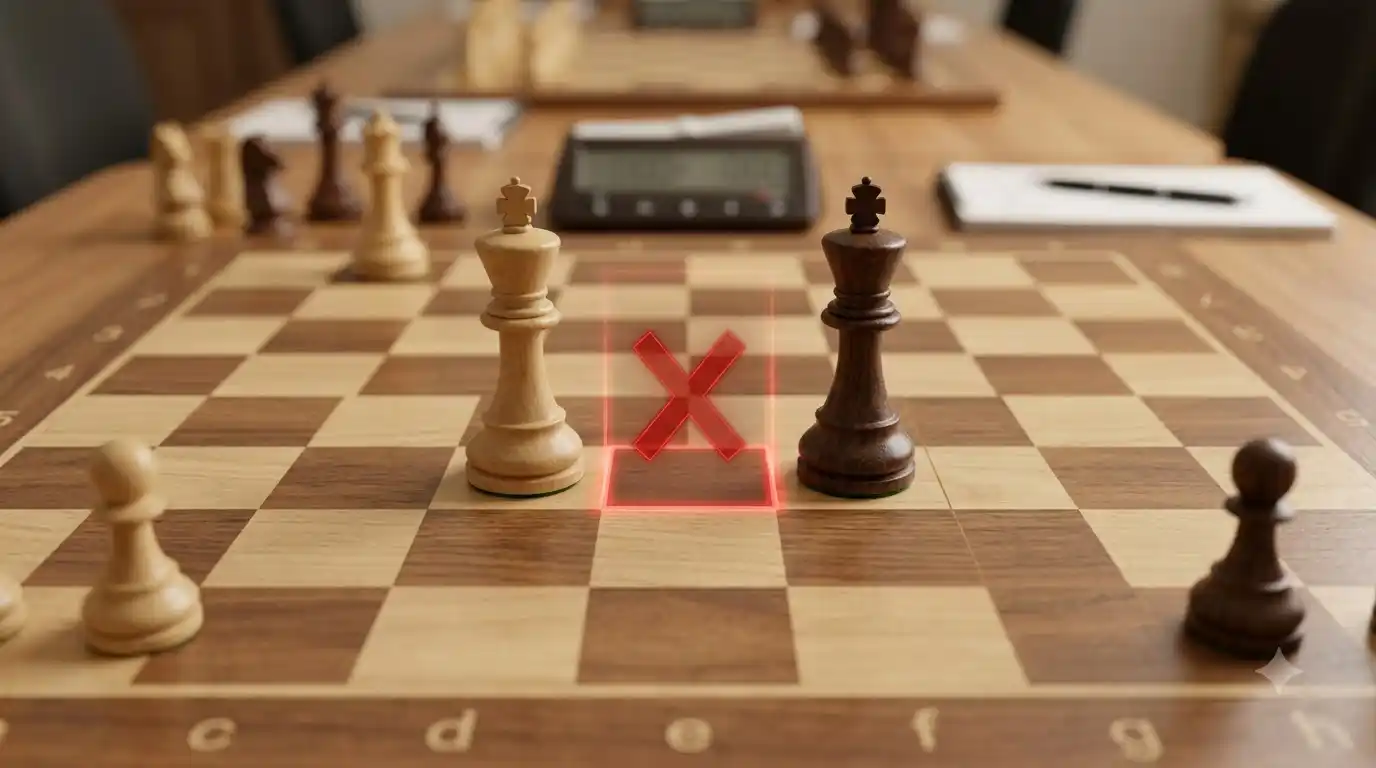
In standard chess, it is physically impossible for a king to deliver a check and therefore impossible to deliver a checkmate to the opposing king. This is due to a fundamental chess law: kings can never be placed on adjacent squares. If a king were to move next to the opponent’s king to “attack” it, it would be stepping into an attacked square itself, which is an illegal move.
Understanding the Rule Against Adjacent Kings
To understand why a king cannot checkmate a king, you must understand how “check” works. A king is in check when it is under direct attack by an opponent’s piece. The rules of chess strictly state that you cannot make a move that places your own king in check.
Because a king attacks exactly one square in every direction around it, moving your king directly next to your opponent’s king means you are stepping into their attack radius.
Let’s look at a quick example: Imagine the board is completely empty except for the White King on e4 and the Black King on e6.
- It is White’s turn. The White King cannot move to d5, e5, or f5, because those squares are controlled by the Black King.
- Stepping onto those squares would place the White King in check, which is illegal.
Because the kings push each other away like opposite magnets, they can never directly threaten one another. Therefore, a king can never deliver a checkmate.

What Happens if Only Two Kings Are Left?
What happens if a fierce game results in all the pawns, knights, bishops, rooks, and queens being captured, leaving only the two kings on the board?
When only the two kings remain, the game immediately ends in a draw by insufficient material. Because neither king can checkmate the other, and there are no other pieces left to deliver a check, it is mathematically impossible for either side to win.
Pro Tip: If you are losing a game and only have your king left, your best defensive strategy is to trade off all remaining pieces on the board to force this exact draw!
How the King Actually Helps Deliver Checkmate
While the answer to “can a king checkmate a king” is no, that does not mean the king is useless in an attack! In fact, the king is a vital supporting piece in almost every endgame checkmate.
Although the king cannot deliver the final blow, it acts as a bodyguard for the piece that does.
For example, when you are trying to deliver a checkmate with a queen and king against a lone enemy king, the queen cannot finish the job alone. She needs her king to defend her.
- The Setup: You use your queen to trap the enemy king against the edge of the board.
- The Support: You march your king across the board to stand right in front of the enemy king.
- The Checkmate: You place your queen directly between the two kings. The enemy king is in checkmate, and he cannot capture your queen because your king is protecting her!
Edge Cases: The Danger of Stalemate
When using your king to assist in an endgame attack, you must be extremely careful not to accidentally cause a stalemate. A stalemate happens when a player has no legal moves left, but their king is not in check. This results in a frustrating draw instead of a win.
A Real Stalemate Example:
- White Queen on f7
- White King on f6
- Black King trapped on h8
If it is Black’s turn to move, the Black King is not in check. However, the only squares the Black King could step to (h7 or g8) are actively attacked by the White Queen. Because Black cannot make a legal move, the game is a stalemate (draw).
To avoid this, always make sure the enemy king has at least two safe squares to step back and forth on until you are ready to deliver the final checkmate.
Master Endgame Precision with Venture Chess Academy
Are you tired of accidentally drawing winning games? Let your child master endgame precision, avoid stalemates, and learn powerful opening traps like the 4-move checkmate with a 60-minute interactive session led by our FIDE-rated coaches.
Free Demo Class for Kids
Let your child explore 60-minute free interactive session with FIDE Rated coaches.
Enroll HereConclusion
So, can a king checkmate a king? Absolutely not. The rules of chess forbid kings from standing on adjacent squares, meaning they can never directly attack each other.
However, your king is far from a helpless bystander. In the endgame, the king transforms from a vulnerable target into a powerful attacking assistant, helping pieces like the queen or rook deliver the final checkmate. Whether you are practicing your endgame technique or debating the merits of online chess vs board chess, understanding the unique limitations and strengths of the king is essential to becoming a well-rounded chess player.
Frequently Asked Questions (FAQs)
No, you cannot checkmate a king with just a king in chess. A single king cannot deliver checkmate because it cannot place the opposing king in check (kings cannot move to adjacent squares) or prevent its escape. This scenario results in a draw due to insufficient material, as neither side can force checkmate with only kings on the board.
If the only pieces left on the board are the two kings, the game immediately ends in a draw due to “insufficient material.” Neither player has enough pieces to force a checkmate.
No piece can actually “kill” or capture a king in chess. The game ends the moment a king is placed in checkmate (an inescapable threat). Furthermore, since kings cannot stand next to each other, they can never attack one another.
While the king cannot deliver the checkmate itself, it provides physical support. In endgames, you use your king to guard your attacking pieces (like a Queen or Rook) so the enemy king cannot capture them when they deliver the final check.
Checkmate means the enemy king is under attack (in check) and has no legal moves to escape resulting in a win. Stalemate means the enemy king is not under attack, but still has no legal moves resulting in a draw.